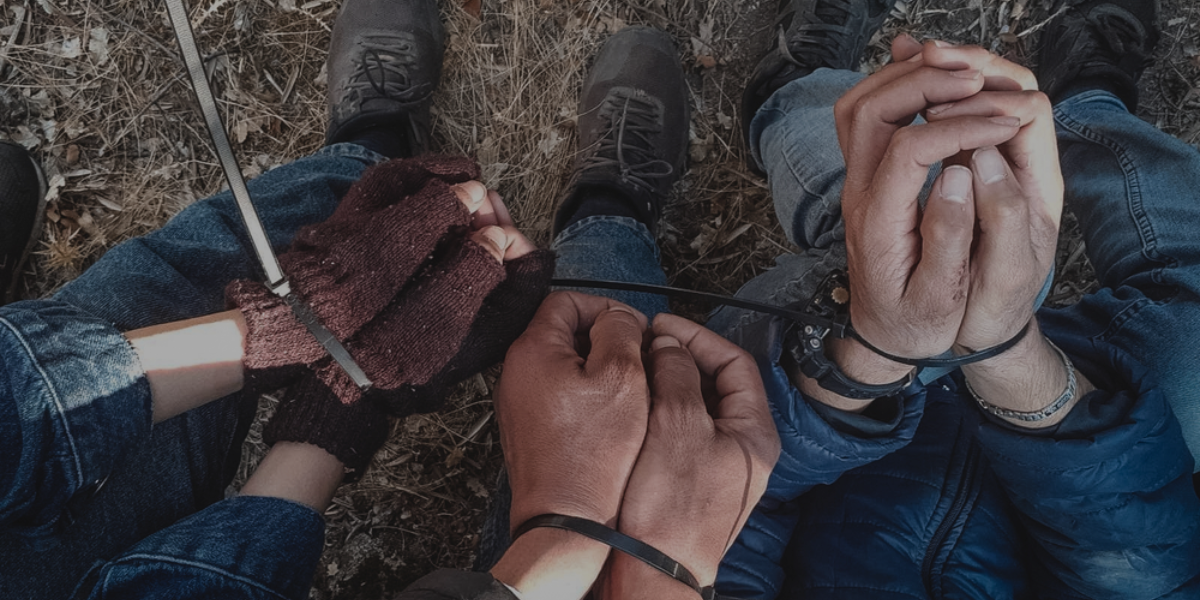
“The men wearing balaclavas were looking at me and laughing while I was drowning.”
Three years after the Pylos tragedy, deadly violence continues in Greece
Three years after the Pylos shipwreck cost 600 lives people are still dying at sea because of political inaction.
“I clearly remember the boat that approached us,” said a male survivor in April 2026.
“I saw the Greek flag and a grey boat with two white stripes. There were four men in total.
“They inflated a small lifeboat that could hold a maximum of 10 people and threw three people directly into it. I initially fell into the sea, next to the engine of the big ship, which was pulling me in, and I was not wearing a life vest. The men wearing balaclavas were looking at me and laughing while I was drowning. The people already inside the inflatable lifeboat grabbed me and helped me.
“We got onto the inflatable boat, which had already filled with water because we were 26 people. A jet boat approached at high speed, tied a rope to the inflatable boat, and started pulling us. At the same time, they were hitting us with a metal rod without looking where they were striking. One man broke his arm, and another one suffered a head injury.
“They left us in deep water. We were shouting and asking for help, and they told us, ‘Goodbye’”.
Pylos was not an isolated tragedy. People are still dying at sea today because authorities inflict intentional violence and policies of deterrence.
“This is happening on European soil from a country that adheres to international human rights conventions, while there is no accountability,” says Sophie Baylac, MSF country coordinator in Greece.
The EU Pact on Migration and Asylum, with its underlying logic of deterrence, also does nothing to address the proliferation of violence at EU borders.
MSF teams in the Greek islands of Lesvos and Samos continue to provide care to people who have experienced violence at sea. While less visible today, violence is the reality at Greece’s and Europe’s borders. Routes may shift, arrivals may fluctuate, and headlines may move elsewhere, but the human cost remains.
“Between July 2023 and June 2026, in Lesvos, we supported over 16,000 people, out of the 26,000 that arrived on the islands. In October 2025 alone, we supported survivors of three shipwrecks. Our teams provided individual medical consultations to men and women who were diagnosed with physical and psychological traumas and injuries consistent with dangerous sea crossings and violent interceptions. Many patients required further medical attention while others demanded emergency ambulance response.” continues Sophie Baylac.
“A group of people tried to drown us by doing circles and they were using drones,” a survivor said. “They stripped us and took our phones and bags and threw them in the sea. They were young and they were shouting, hitting us with sticks and taking pictures and videos of us. Then, they broke our motor and threw a plastic basket in the sea. They put us inside this basket and let us in the sea. Out of 25 people in the group, only one person knew how to swim.”
Our patients describe repeated crossing attempts, beatings, pushbacks, threats, humiliation, missing relatives, and being abandoned at sea. The fear and the trauma do not end when they reach land as continuous uncertainty and limited access to support contribute to ongoing psychological distress.
“A large ship turned on its spotlights in the distance and approached us without stopping. They did not say anything to us. We were very close to the shore and needed about 10 more minutes to reach land. The large ship left, and then a jet boat with three people appeared. They began circling around us, creating waves, and we were forced to stop.
“After that, they told us, ‘Relax, ok, Yunan (Greece).’ One of the men from the jet boat jumped into our small boat, took control of it, and repeated, ‘Ok, Yunan.’ Then he began to manoeuvre the boat abruptly. The women started shouting in panic, begging him in English and calling for help, but he responded, ‘Fuck you, no Yunan,’ while speeding the boat. Since the jet boat was now very close to us, it began pushing and hitting our boat from behind. He continued driving our boat for about one hour until we reached an area where the waves were very high. It had taken us seven hours to get there, but he covered the distance in just one hour. Then he stopped the boat, damaged the engine, and used a sharp object to make a hole in it,” said a male survivor.
In January 2025, the European Court of Human Rights confirmed Greece’s systematic practise of pushbacks to Turkey. The Frontex Fundamental Rights Office report found a broader pattern of the Hellenic Coast Guard patrol boat manoeuvres that put the lives of those on board at risk. These are not unfortunate exceptions, but recurring consequences of the current deterrence practices at sea.
A male survivor recounted his experience to MSF in March 2026.
“We were on a small boat in the middle of the night, when we saw a large Greek coastguard boat. They shone a bright light on us and signalled for us to stop. The big boat began circling to force us back.
“They lowered a smaller, faster boat with four people inside. All of them wore masks, revealing only their eyes and noses, and they spoke in English. They struck our engine with something like a spear or harpoon, and the boat started taking on water. They hit us again with the same object, and the boat split into two pieces. I didn’t have a life vest.
“They started pushing us and creating waves. I tried to climb onto the big Greek boat, but someone from the smaller Greek boat hit me. People were screaming and drowning. I tried to save some people by pulling them up. The woman who died was behind me and was pulling me from the neck because she was drowning. I told her to let go because I was not wearing a life vest, but she was not wearing one either and drowned.”.
Three years after Pylos, violence at sea continues amidst deafening silence and the normalisation of suffering.
“The indiscriminate violence and dangerous interception practices at sea need to stop. We don’t believe governments should make boats sink.” says Sophie Baylac.